
Guide · Schools
How to build a wooden boat with students
Which boat to choose, what you need, how to share out the work and how to get safely to launch day. Based on the public Bevin’s Skiff building manual and on what we have learned in Bote al Agua’s workshop in Tigre, Argentina.
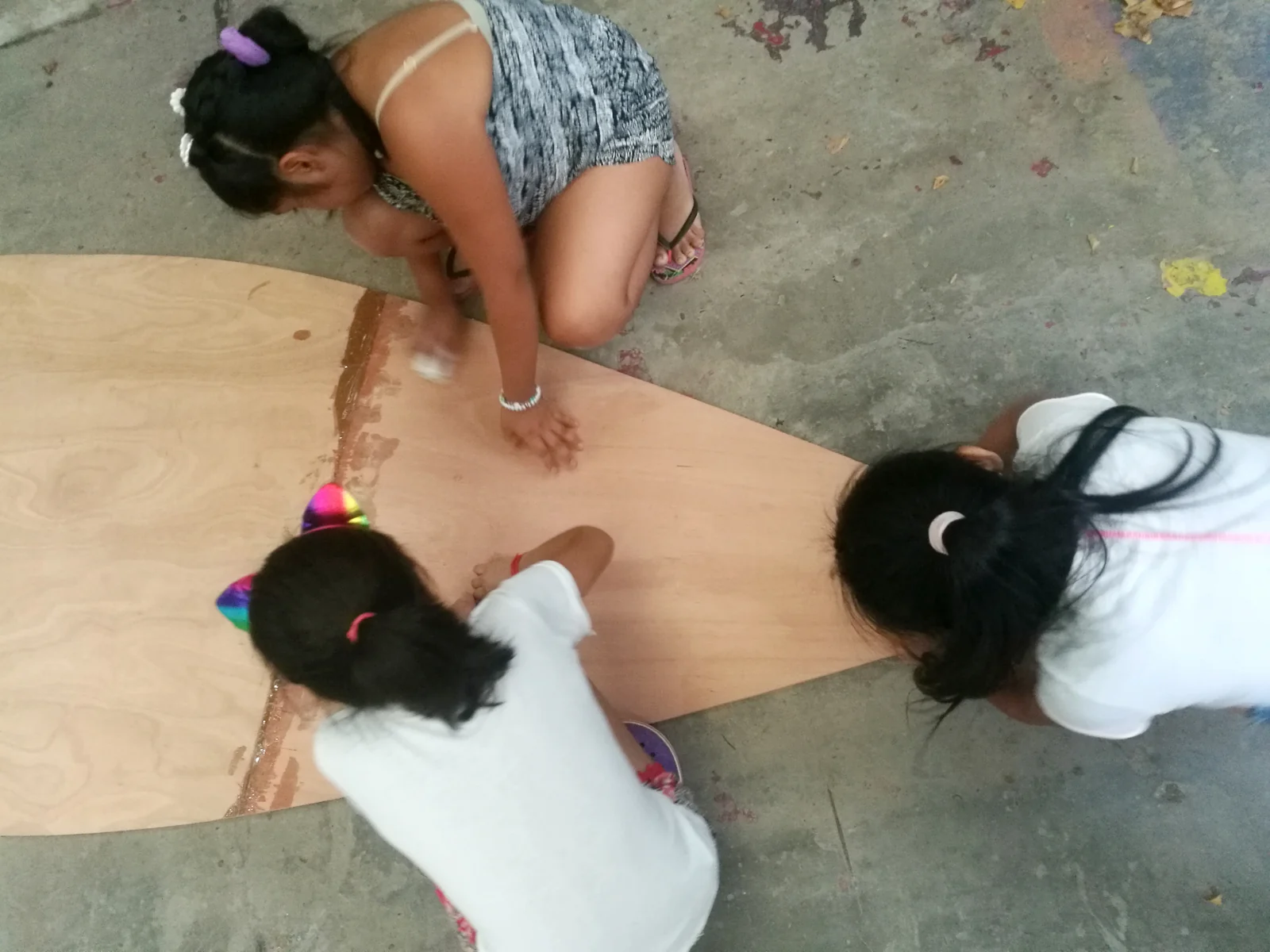
Can a school really build a boat?
Yes. Schools and non-profits have been doing it for decades in the United States, Europe and South America, and in Tigre, a river town about 30 km north of Buenos Aires, we have done it with public and private schools since 2018. The key is not having a shipyard: it is choosing a design meant for beginners, preparing the parts well and organising the work so everyone has something to do.
This guide brings together two sources: the Bevin’s Skiff building manual, for a boat created as a teaching tool by the Alexandria Seaport Foundation in Virginia, USA, and the experience of Bote al Agua’s workshop, as documented by the Argentine press.
Which boat should you build with students?
A first school boat should be flat-bottomed, with few parts, easy-to-find materials and a size that fits your workshop. Two designs that work:
| Spec | Bevin’s Skiff | Bote al Agua lagoon boat |
|---|---|---|
| Length | 11′8″ (about 3.56 m) | 3.85 m (12′8″) |
| Beam | Not listed on the design page | 1.15 m (3′9″) |
| Weight | 120 lb (about 54 kg) | — |
| Capacity | 460 lb (about 209 kg) | 4 kids and a pair of oars |
| Use | Rowing or sailing (optional rig) | Rowing |
| Source | Alexandria Seaport Foundation (opens in a new tab) | La Nación, 30 May 2023 (opens in a new tab) |
The Alexandria Seaport Foundation describes Bevin’s Skiff as a small, traditional boat that is easy to build and use, designed as an enjoyable first boatbuilding experience. In Argentina, Bevin’s Skiff is also the boat chosen for the wooden boat building course for adults that Bote al Agua announced in 2026 with Artetra Templo Taller.
Where can you get the plans and the manual?
On the Alexandria Seaport Foundation’s Bevin’s Skiff page (opens in a new tab) you can download the construction guide (PDF) (opens in a new tab) and the materials list (PDF) (opens in a new tab) for free. The full plans are ordered from the foundation by email for a donation, which gives you the right to build two boats; for each additional boat they ask for a royalty. At the time of writing, the foundation states that it is not selling kits.
The manual distinguishes kit builders, who receive ready-made parts, from plan builders, who source the timber and make every part themselves. With a school class, preparing a kit before you start saves many hours: at Bote al Agua, kids assemble the hull from a kit of pre-cut parts (PRESENTE RSE, 2021 (opens in a new tab)).
What materials and tools do you need?
The Bevin’s Skiff list includes, among other things:
- Three sheets of 3/8″ marine plywood, 4 × 8 ft, for the sides, bottom, foredeck and gussets. The manual recommends marine plywood to the BS 1088 standard.
- Solid timber: white oak for the stem, and spruce or fir for the frames, transom, chines, rails, keel and skeg.
- Two adhesives: epoxy and a polyurethane adhesive, plus nails and screws.
- Basic tools (for kit builders): two sawhorses, a claw hammer, a bucking iron to back up the nailing, a hand saw, a bevel gauge, a combination square, pencils, a chalk line, screwdrivers, a hand plane, at least two 4″ C-clamps and a hand drill with bits for pilot holes and countersinks. Plan builders also need a table saw and a circular saw.
In our workshop, kids learn to use saws, planes, measuring tools, chisels, hammers and glues (La Nación, 2023 (opens in a new tab)). If your school has no woodshop, look for a local non-profit, rowing club or boatbuilder who can support the project: someone with real boat experience makes all the difference.
Step by step: from kit to river
The Bevin’s Skiff manual is divided into five units. Because the boat was designed as a teaching tool, the order follows the best sequence for teaching maths, so laying out and cutting the parts comes last, even though plan builders do it first.
- Before you start: the model. The manual recommends building a cardstock model first, to see how the parts fit together. At Bote al Agua, the first task is a scale model loaded with screws and coins to explain Archimedes’ principle (La Nación, 2023 (opens in a new tab)).
- Forming the boat (unit 1). Nail the sides to the stem, set the boat on the sawhorses and fit the centre frame and the transom.
- Attaching the bottom (unit 2). Fit the chines to the stem and transom by measuring compound angles, plane them so the bottom sits flat, then nail the bottom on every 4 inches, starting from the centre.
- Building the interior (unit 3). Deck beam, quarter knees, frames and seat risers. As the manual puts it: “lots of isosceles triangles!”
- Finishing the outside (unit 4). Rails, foredeck, keel and skeg, seats, oarlock sockets, filling, sanding, paint, the painter (bow line) and the oars.
- Making the kit (unit 5). Cut the stem, build the transom, scarf the plywood panels with epoxy (the manual asks for at least 24 hours of curing) and lay out the sides and the bottom.
Then comes the best part: the launch. At Bote al Agua the group votes on the boat’s name, takes it to the river and rows it with families invited (PRESENTE RSE, 2021 (opens in a new tab)).
How do you organise a group so everyone works?
What works for us in Tigre, according to published accounts of the workshop:
- Groups of about 12 kids, meeting for two hours a week. Between 9 and 12 sessions are enough to go from the first cut to the launch, in about three months (La Nación, 2023 (opens in a new tab)).
- Always the same design. Repeating the boat lets you prepare the kit better and anticipate where each group gets stuck.
- Parallel tasks. While some nail the bottom, others sand, measure the next part or prepare the seats.
- Power tools stay with the instructors. Kids glue, nail, screw, saw, plane and sand; adults run the machines (PRESENTE RSE, 2021 (opens in a new tab)).
Workshop safety
The Bevin’s Skiff manual opens with safety. Its basic rules apply to any school workshop:
- Wear safety glasses, hearing protection and nitrile gloves.
- Keep your hands behind the cutting edge of the tool.
- Know how to use each tool before you start, and if you don’t, ask someone who does.
- Take care with adhesives: the manual warns that epoxy can sensitise the skin and that polyurethane adhesive “is not totally benign”. Clean up squeeze-out before it dries.
- Read each step all the way through before you mark or cut the wood.
On launch day, follow the local rules for rowing boats. In Argentina, the Prefectura Naval Argentina (coast guard) makes life jackets compulsory in rowing boats and requires under-18s to be accompanied by adults; see our guide to river safety for kids.
Frequently asked questions
Are the Bevin’s Skiff plans free?
The construction guide and the materials list are free downloads on the Alexandria Seaport Foundation website. The full plans are available from the foundation for a donation, which gives you the right to build two boats; the current amount is listed on its page.
How long does it take a class to build a boat?
It depends on the group and on the kit. At Bote al Agua, a group of about 12 kids working from pre-cut parts needs 9 to 12 two-hour sessions, roughly three months, to reach the launch.
Do the kids use power tools?
Not in Bote al Agua’s workshop: kids use saws, planes, chisels, hammers and glues, and power tools stay with the instructors.
Sources
Checked on 11 October 2026. All links go to the original publication.
- Alexandria Seaport Foundation, “Bevin’s Skiff” (opens in a new tab) (boat specs, plans and downloads).
- Alexandria Seaport Foundation, “Bevin’s Skiff Building Manual” (opens in a new tab) (PDF, 2012).
- La Nación, “Pequeños carpinteros: chicos de Tigre construyen un bote para entender el principio de Arquímedes” (opens in a new tab), 30 May 2023 (in Spanish).
- PRESENTE RSE, “Bote al Agua: educar para construir” (opens in a new tab), 24 November 2021 (in Spanish).
- Prefectura Naval Argentina, “Recomendaciones para el navegante con kayaks y botes a remo” (opens in a new tab) (in Spanish).
Want to do this with your school?
If you are a teacher or school leader and would like your class to build its own boat, see how our workshops for schools work, or message us on Instagram (our channels are in Spanish).