
Schools · Learning by doing
Wooden boat building workshops for schools
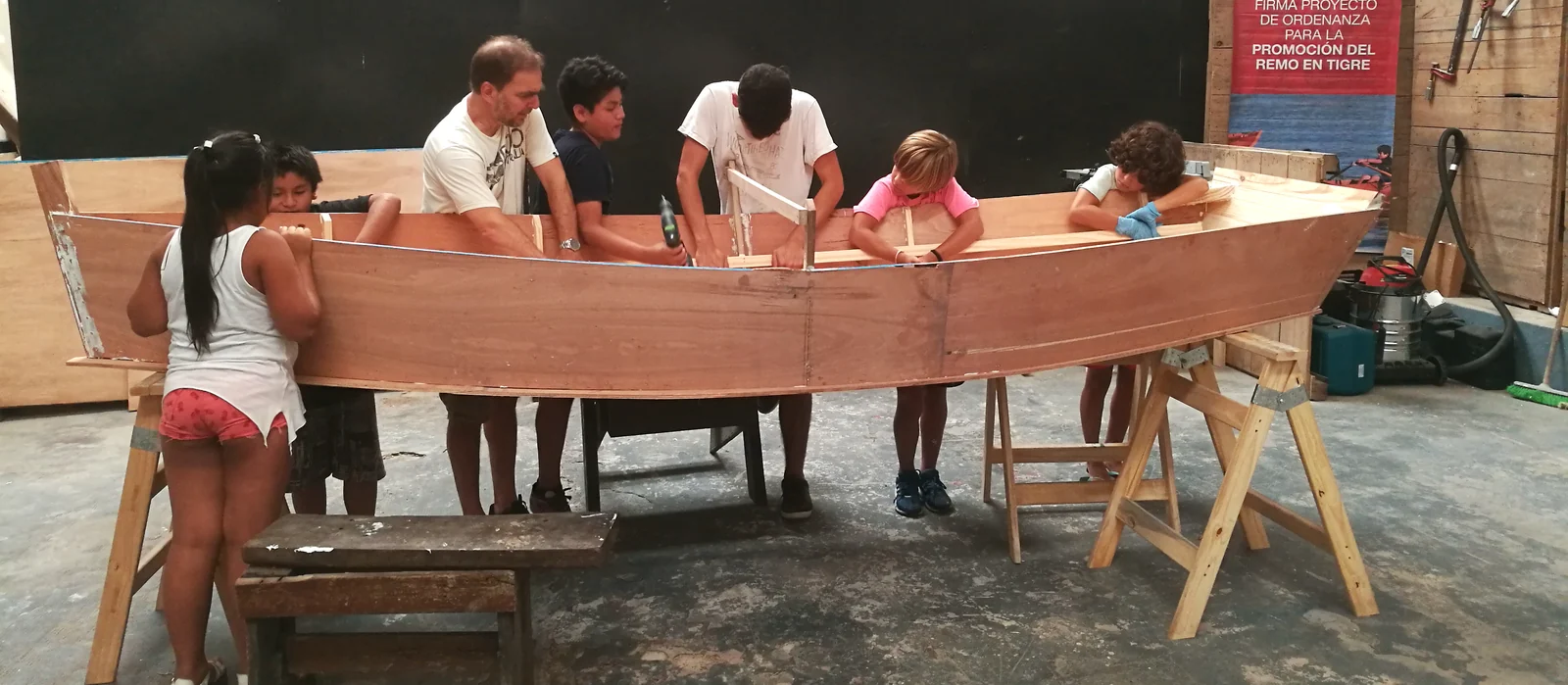
A whole class builds a real wooden rowing boat with hand tools, then takes it out on the river. This is how Bote al Agua, a non-profit in Tigre, Argentina, works with public and private schools.
What is the workshop?
Where we are: Tigre is a river town about 30 km north of Buenos Aires, Argentina, at the gateway to the Paraná Delta. Rowing and riverside clubs are part of everyday life here.
Bote al Agua uses project-based learning (PBL). The project is concrete: building a wooden rowing boat as a team. The boat is the vehicle for learning geometry, trigonometry, tool skills and teamwork.
According to the Argentine newspaper La Nación (opens in a new tab) (May 2023), the workshop always builds the same design: a flat-bottomed lagoon boat, 3.85 m long with a 1.15 m beam, for four kids and a pair of oars.
Which year groups and ages?
The workshop has run with very different schools:
- Third-year groups from a public school in Tigre Sur, as part of their curriculum (PRESENTE RSE, 2021).
- Pupils finishing primary school at Los Biguaes, a school on the Carapachay river in the Delta (Philippe Enquin, 2023).
- Fourth-year students of Colegio Michael Ham, within Vicente López's STEAM network (InfoBAN, 2021), and students of the technical school EEST Nº 3, who rowed their boat on the Río de la Plata (CACEL, 2022).
- Sixth-grade kids from Escuela Municipal Malvinas Argentinas in 2026.
Private schools also book the workshop as a paid course.
How does a workshop work, step by step?
- The scale model. A miniature boat loaded with screws and coins: the load weighs more than the boat, yet it floats. That is how Archimedes' principle is explained.
- Measure and mark out. Angles, symmetry and some trigonometry: every piece must sit parallel or perpendicular to the next.
- Build the hull. From a kit of pre-cut parts: gluing, nailing, screwing and sawing. Power tools stay with the instructors.
- Finishing. Seats, oarlocks and paint. The group votes on the boat's name.
- Launch. The boat goes into the river and the group rows it, with families invited.
Groups have about 12 kids, meeting for two hours a week: 9 to 12 sessions, roughly three months.
What do kids learn?
- Hands-on maths measuring, angles, symmetry, geometry and trigonometry
- Physics buoyancy and Archimedes' principle
- Hand tools saw, plane, chisels, hammer, glues
- Planning setting goals and reaching them
- Teamwork nobody builds a boat alone
- Caring for the river responsible use of wood and respect for nature
Where does it take place?
The workshop is based in a shed in Tigre, near the San Fernando canal. Projects with schools from neighbouring districts have ended with a launch on their own shore, as in Vicente López on the Río de la Plata.
“Cuando los chicos se sienten protagonistas del proyecto incorporan conocimientos más rápido.” (“When kids feel the project is theirs, they learn faster.” — our translation)
Frequently asked questions
Do kids need woodworking experience?
No. In the workshop they learn to use saws, planes, measuring tools, chisels, hammers and glues. Power tools are used by the instructors.
How long does the workshop last?
Between 9 and 12 two-hour sessions, one a week: about three months from the first cut to the launch.
Can private schools take part?
Yes. Private schools book the course, and that income helps fund workshops for kids from neighbourhoods in Tigre.
What happens to the boat at the end?
It is launched and rowed on the river. Many boats have been sold or exchanged for donations, and one built by Colegio Michael Ham students was donated to the municipal rowing school of Vicente López.
How do we get started?
Message us on Instagram or Facebook with your school, the year group and the number of students, and we will plan the workshop together. Get in touch to ask about dates.
Want to get involved?
Send us a direct message on Instagram or Facebook. Tell us who you are and what you are interested in, and we will get back to you with dates and details. Our channels are in Spanish.