Guide · Learning by doing
Project-based learning through boat building
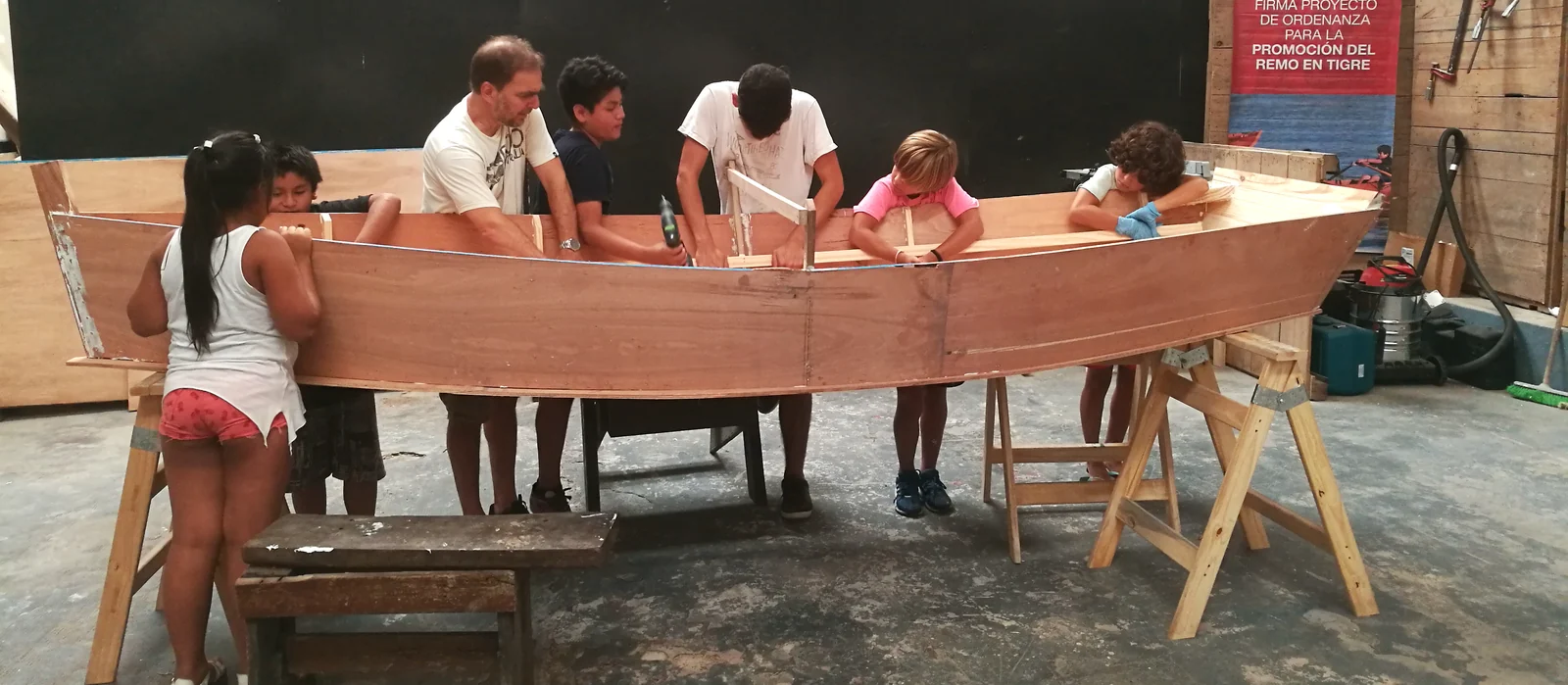
Project-based learning (PBL) organises teaching around a real challenge, and few challenges are as real as a boat that has to float. Here is how the seven elements of PBL map onto a boatbuilding workshop.
What is project-based learning?
In project-based learning (PBL), students learn by working over an extended period to solve a problem or answer a question, and they finish with a product they share with other people. It is not the “hands-on activity” at the end of a unit: the project is the unit.
PBLWorks, the US organisation dedicated to PBL (formerly the Buck Institute for Education), sets out a model called “Gold Standard PBL” (opens in a new tab): projects target curriculum content as well as skills such as critical thinking, problem solving, communication, self-management, project management and collaboration.
Why is a boat such a good project?
Because it ends with a test nobody can argue with: it floats or it doesn’t. And getting there takes measuring, working out angles, understanding buoyancy, planning and teamwork. In a 2025 post, Bote al Agua put it this way: the boat becomes an excuse to pass on teamwork, among many other virtues of this method.
We are not alone in thinking so. The Alexandria Seaport Foundation’s manual explains that Bevin’s Skiff was originally designed as a teaching tool (opens in a new tab): its instructions double as a maths instructors’ guide, and the order of the steps follows the best sequence for teaching. In the United States there is a whole network of educators who teach maths and science by building boats, the Teaching With Small Boats Alliance (opens in a new tab).
The seven elements of PBL in a boat workshop
PBLWorks proposes seven essential project design elements. This is how they look in a boatbuilding workshop:
| Element (PBLWorks) | In a boat workshop |
|---|---|
| A challenging problem or question | Can we, together, build a boat that floats and takes us out on the river? |
| Sustained inquiry | Weeks of questions: why does a loaded boat float, how do you transfer an angle, how much glue is enough? |
| Authenticity | Real tools, materials and quality standards: if a joint doesn’t close, water comes in. |
| Student voice and choice | The group decides how to share tasks, picks colours and votes on the boat’s name. |
| Reflection | Looking back at what worked in each session. At Brooklyn Boatworks, each student serves as “Captain of the Day” and writes a reflective post. |
| Critique and revision | Measure, test the fit, correct and measure again before nailing. |
| Public product | The launch: the boat goes into the river in front of families and the school. |
The description of each element is from PBLWorks (opens in a new tab); the examples are ours. The Brooklyn Boatworks detail comes from its official website (opens in a new tab).
What does the research say about PBL?
One of the most cited studies is a randomised controlled trial by researchers at the University of Southern California (USC) in Advanced Placement (AP) high school courses in the United States. According to the research brief published by the College Board (opens in a new tab):
- In 2016–17 the study covered 3,645 students, 74 teachers and 68 schools in five mostly urban districts.
- Without the project approach, about 37% of students earned a credit-qualifying score (3 or higher out of 5); with the “Knowledge in Action” PBL programme, that rose to 45%: about 8 percentage points more.
- In the second year, students of teachers with a year of practice in the method saw a 10-percentage-point boost.
- The effect was similar for students from low-income and higher-income households.
Two honest caveats: the study was funded by Lucas Education Research, a division of the George Lucas Educational Foundation, which promotes PBL; and it measured government and environmental science courses, not boatbuilding. It is evidence that well-designed PBL does not compete with content, but it proves nothing specific about boats.
Which subjects does building a boat cover?
- Maths measuring, angles, symmetry, parallels and perpendiculars, trigonometry (La Nación, 2019; PRESENTE RSE, 2021)
- Physics buoyancy and Archimedes’ principle, with a scale model loaded with screws and coins (La Nación, 2023)
- Fractions and geometry one step in the Bevin’s Skiff manual warns: “Caution! Fractions ahead.”
- Technology hand tools, adhesives and making processes
- Skills planning, collaboration and perseverance
- Environment the river as a classroom, and care for wood and water
For details on each topic, see the articles in La Nación (2019) (opens in a new tab), PRESENTE RSE (2021) (opens in a new tab) and La Nación (2023) (opens in a new tab) about our workshop (in Spanish).
How to start a boat project at your school
- Write the driving question with your colleagues: concrete, challenging and one that requires this year’s content.
- Choose a proven, flat-bottomed design. Our guide how to build a wooden boat with students compares two options.
- Bring in someone who knows boats: a non-profit, a rowing club or a boatbuilder.
- Map the content: which maths, physics or technology topic appears at each stage of the build.
- Plan for reflection: a fixed moment in every session to review the work.
- Set a launch date and invite families from the start: a public product motivates.
“Cuando los chicos se sienten protagonistas del proyecto incorporan conocimientos más rápido.” (“When kids feel the project is theirs, they learn faster.” — our translation)
Daniel Helft developed these ideas in his talk “Aprender haciendo” (Learning by doing) (opens in a new tab), given at TEDxTigre in 2022 (in Spanish).
Sources
Checked on 11 October 2026. All links go to the original publication.
- PBLWorks, “Gold Standard PBL: Essential Project Design Elements” (opens in a new tab).
- College Board, “Project-Based Learning Boosts Student Achievement in AP Courses” (opens in a new tab) (research brief, PDF).
- Alexandria Seaport Foundation, “Bevin’s Skiff Building Manual” (opens in a new tab) (PDF, 2012).
- Brooklyn Boatworks, official website (opens in a new tab) (programme in New York City middle schools).
- Teaching With Small Boats Alliance, official website (opens in a new tab).
- La Nación, “A través de un taller de construcción de botes, enseña álgebra y trigonometría a chicos en Tigre” (opens in a new tab), 7 February 2019 (in Spanish).
- La Nación, “Pequeños carpinteros” (opens in a new tab), 30 May 2023; PRESENTE RSE, “Bote al Agua: educar para construir” (opens in a new tab), 24 November 2021 (in Spanish).
- TED, Daniel Helft, “Aprender haciendo” (opens in a new tab) (TEDxTigre, 2022, in Spanish).
Want a project like this at your school?
Bote al Agua supports public and private schools in Tigre, Argentina, as they build their own boat, from the scale model to the launch.